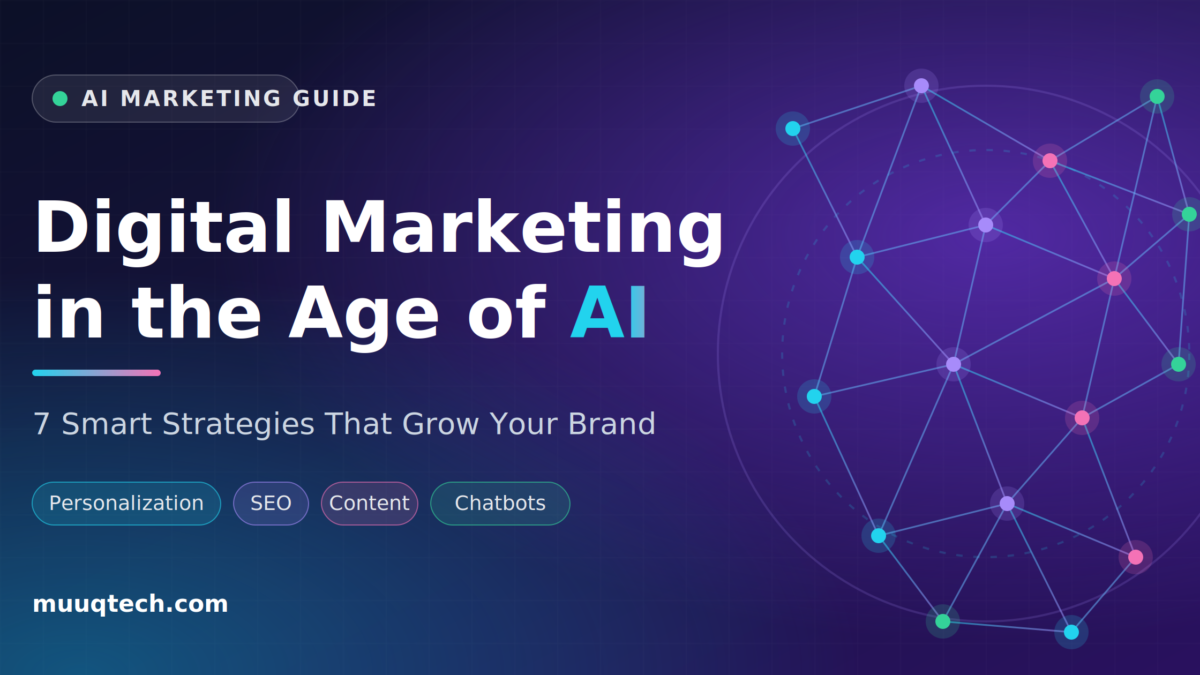
How artificial intelligence is reshaping the way brands find, understand, and win customers
Digital marketing has always rewarded the teams that move fastest with the best data. Artificial intelligence has changed what “fast” and “best” mean. Tasks that once took a team days, such as segmenting an audience, drafting fifty ad variations, or forecasting next quarter’s demand, can now take minutes. But the brands winning with AI are not simply doing more; they are doing smarter, more personal, and more measurable work. This article covers where AI delivers the most value in digital marketing today, and how to use it well.https://www.marketermilk.com/blog/ai-marketing-tools
1. Hyper-Personalization at Scale
Personalization used to mean inserting a first name into an email. Today, AI models analyze browsing behavior, purchase history, location, device, and timing to tailor entire experiences for each person.
- Product recommendations that adapt in real time, the approach made famous by Amazon and Netflix.
- Dynamic website content that changes headlines, offers, and layouts based on the visitor.
- Personalized email journeys where subject lines, send times, and content blocks differ for every subscriber.
The result is higher engagement, better conversion rates, and customers who feel understood rather than targeted.
2. Generative AI for Content Creation
Generative AI has become a daily tool for marketing teams. It can draft blog outlines, social captions, product descriptions, video scripts, and ad copy in seconds, and produce images and short videos for campaigns.https://muuqtech.com/2026/07/24/relay-types-working-principle-applications/
The best use is as a collaborator, not a replacement. AI is excellent at first drafts, variations, repurposing (turning one webinar into a blog post, five posts, and a newsletter), and translation. Humans still provide strategy, brand voice, original insight, and fact-checking. Content that is purely machine-generated tends to sound generic, and audiences and search engines increasingly reward material with real expertise and a distinct point of view.
3. Smarter SEO and Search Strategy
AI is transforming both how marketers optimize for search and how people search.
- Keyword and topic research: AI tools cluster keywords by intent and reveal content gaps competitors have missed.
- On-page optimization: Tools suggest improvements to structure, headings, and internal links.
- AI-powered search: With AI summaries and chat-based assistants answering questions directly, brands now need to be cited and trusted sources. Clear, well-structured, authoritative content with original data is more likely to be surfaced.
The lesson: optimize for people’s questions and real expertise, not just for keywords.
4. Predictive Analytics and Customer Insights
One of AI’s strongest capabilities is finding patterns humans cannot see. Predictive models help marketers:
- Forecast which leads are most likely to convert (lead scoring).
- Identify customers at risk of leaving (churn prediction).
- Estimate customer lifetime value to decide where to invest budget.
- Anticipate seasonal demand and trending topics.
Instead of reacting to last month’s report, teams can act on what is likely to happen next.
5. Automated and Optimized Advertising
Ad platforms such as Google and Meta already use AI to bid, target, and allocate budget. Marketers can go further by using AI to:
- Generate and test dozens of creative variations automatically.
- Adjust bids and budgets across channels in real time.
- Build lookalike audiences from your best customers.
- Detect ad fatigue and refresh creative before performance drops.
This frees marketers from manual tweaking so they can focus on messaging, offers, and overall strategy.https://muuqtech.com/2026/07/14/lendela-review-2026/
6. Conversational Marketing: Chatbots and AI Assistants
Modern AI chat assistants are far more capable than the rigid bots of the past. They can answer product questions, qualify leads, recommend items, book appointments, and support customers around the clock, in multiple languages. For businesses in growing markets, this makes high-quality, always-on service affordable even for small teams.
7. Social Media Listening and Community Management
AI can scan thousands of mentions, comments, and reviews to measure sentiment, spot emerging trends, and flag potential PR issues early. It can also help schedule posts, suggest the best times to publish, and draft replies, while humans handle sensitive or nuanced conversations.
Best Practices for Using AI in Marketing
- Start with a goal, not a tool. Define the problem (more leads, lower acquisition cost, better retention) before choosing software.
- Keep a human in the loop. Review AI output for accuracy, tone, and brand fit.
- Protect customer data. Follow privacy laws and be transparent about how data is used. Trust is a competitive advantage.
- Be honest. Avoid fake reviews, misleading images, or undisclosed AI-generated content that could mislead your audience.
- Test and measure. Run experiments, compare against baselines, and keep what works.
- Invest in skills. Train your team in prompting, data literacy, and critical evaluation of AI output.
Common Pitfalls to Avoid
- Over-automation: Too much automation makes a brand feel robotic.
- Bias in data: Models trained on skewed data can exclude or misrepresent groups of customers.
- Chasing every new tool: A small, well-integrated toolkit beats a pile of disconnected apps.
- Neglecting creativity: AI can optimize what exists, but breakthrough ideas still come from people.
What’s Next
Expect AI to become even more embedded in marketing: autonomous agents running multi-step campaigns, real-time video personalization, voice and visual search, and deeper integration between analytics, creative, and customer service. The marketers who thrive will combine machine speed with human judgment, empathy, and originality.
Conclusion
The best digital marketing in AI is not about replacing marketers; it is about amplifying them. By using AI for personalization, content, search, prediction, advertising, and customer engagement, and by pairing it with strong strategy, ethics, and creativity, brands can reach the right people with the right message at the right moment. The opportunity is enormous for those who start now, learn continuously, and keep the customer at the center of every decision.
Muuq Tech