Physical Address
304 North Cardinal St.
Dorchester Center, MA 02124
Physical Address
304 North Cardinal St.
Dorchester Center, MA 02124

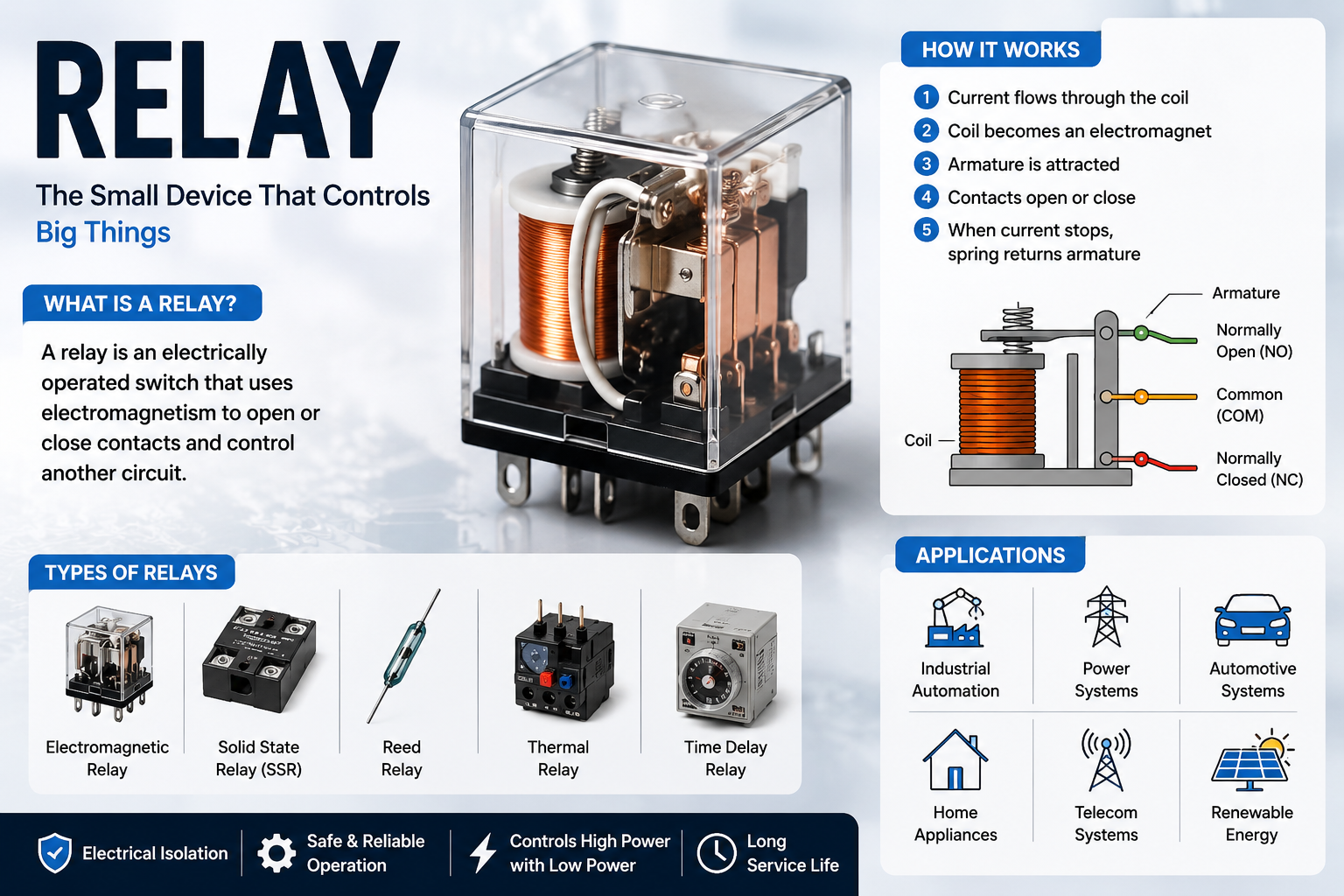
The word relay has different meanings depending on the field in which it is used, but the core idea remains the same: a relay transfers, controls, or passes something from one point to another. Whether it is electricity flowing through a circuit, data traveling across a network, or a team passing a baton in a race, a relay serves as a bridge that enables efficient operation.
Today, relays play a critical role in electrical engineering, industrial automation, telecommunications, transportation, and modern computing.
A relay is an electrically operated switch designed to control one electrical circuit using another. Instead of manually opening or closing a switch, a relay uses an electrical signal to perform the switching automatically.
Relays are essential because they allow low-power circuits to safely control high-power devices. This capability improves automation, enhances safety, and increases system reliability. https://pickrelay.pxf.io/qWN2Wq
A traditional electromagnetic relay consists of several key components:
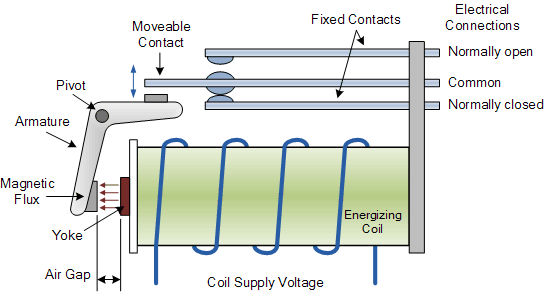
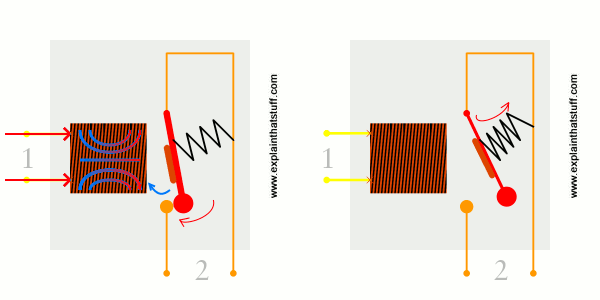
This simple mechanism enables complex automation systems to operate safely and efficiently.
The most traditional type, using magnetic force to operate mechanical contacts. These relays are widely used in industrial machinery and power systems.
Instead of mechanical contacts, solid-state relays use semiconductor devices. They operate silently, switch faster, and have a longer service life because there are no moving parts.
A reed relay contains sealed magnetic contacts enclosed in a glass tube. It is commonly used in precision instruments and communication equipment.
Thermal relays protect motors from overheating by responding to excessive current that generates heat.
These relays introduce a programmed delay before switching on or off, making them useful in industrial automation and process control.https://pickrelay.pxf.io/qWN2Wq
Relays offer numerous benefits, including:
These advantages make relays indispensable across many industries.
Factories use relays to control motors, conveyor belts, robotic systems, and manufacturing equipment.
Electrical substations rely on protective relays to detect faults and disconnect damaged equipment before serious failures occur. https://muuqtech.com/2026/07/15/coohom-commission-program/
Modern vehicles use relays for headlights, fuel pumps, starter motors, cooling fans, and air-conditioning systems.
Relays are found in washing machines, refrigerators, microwave ovens, air conditioners, and HVAC systems.
Communication equipment uses relays for signal routing, network switching, and system protection.
Solar power plants and wind farms employ relays to monitor electrical conditions and protect inverters, transformers, and distribution networks.https://muuqtech.com/2026/07/13/nordvpn-review-2026-2/
Although both devices are used in electrical systems, they perform different functions.
| Relay | Circuit Breaker |
|---|---|
| Detects electrical conditions | Interrupts current flow |
| Sends control signals | Physically disconnects circuits |
| Acts as a sensing and control device | Acts as a protection device |
| Requires another switching device in many systems | Directly protects electrical equipment |
In modern power systems, relays and circuit breakers often work together to provide comprehensive protection.
As automation and smart technologies continue to evolve, relays remain fundamental components of electrical infrastructure. They enable intelligent control systems, improve operational efficiency, reduce human intervention, and enhance equipment protection.
Even with advances in programmable logic controllers (PLCs), Internet of Things (IoT) devices, and digital control systems, relays continue to provide reliable switching and protection in countless applications.
Relay technology is evolving toward greater intelligence and connectivity. Modern digital relays feature:
These innovations support more resilient, efficient, and sustainable electrical systems.
Relays are among the most important components in electrical and electronic engineering. By allowing one circuit to safely control another, they make automation, protection, and efficient power management possible. From household appliances to industrial machinery, renewable energy systems, and national power grids, relays ensure that modern technology operates safely and reliably.
As industries continue to embrace digital transformation and intelligent automation, the role of relays will remain vital. Their combination of simplicity, reliability, and adaptability ensures they will continue to be a cornerstone of electrical systems for years to come.
