Physical Address
304 North Cardinal St.
Dorchester Center, MA 02124
Physical Address
304 North Cardinal St.
Dorchester Center, MA 02124

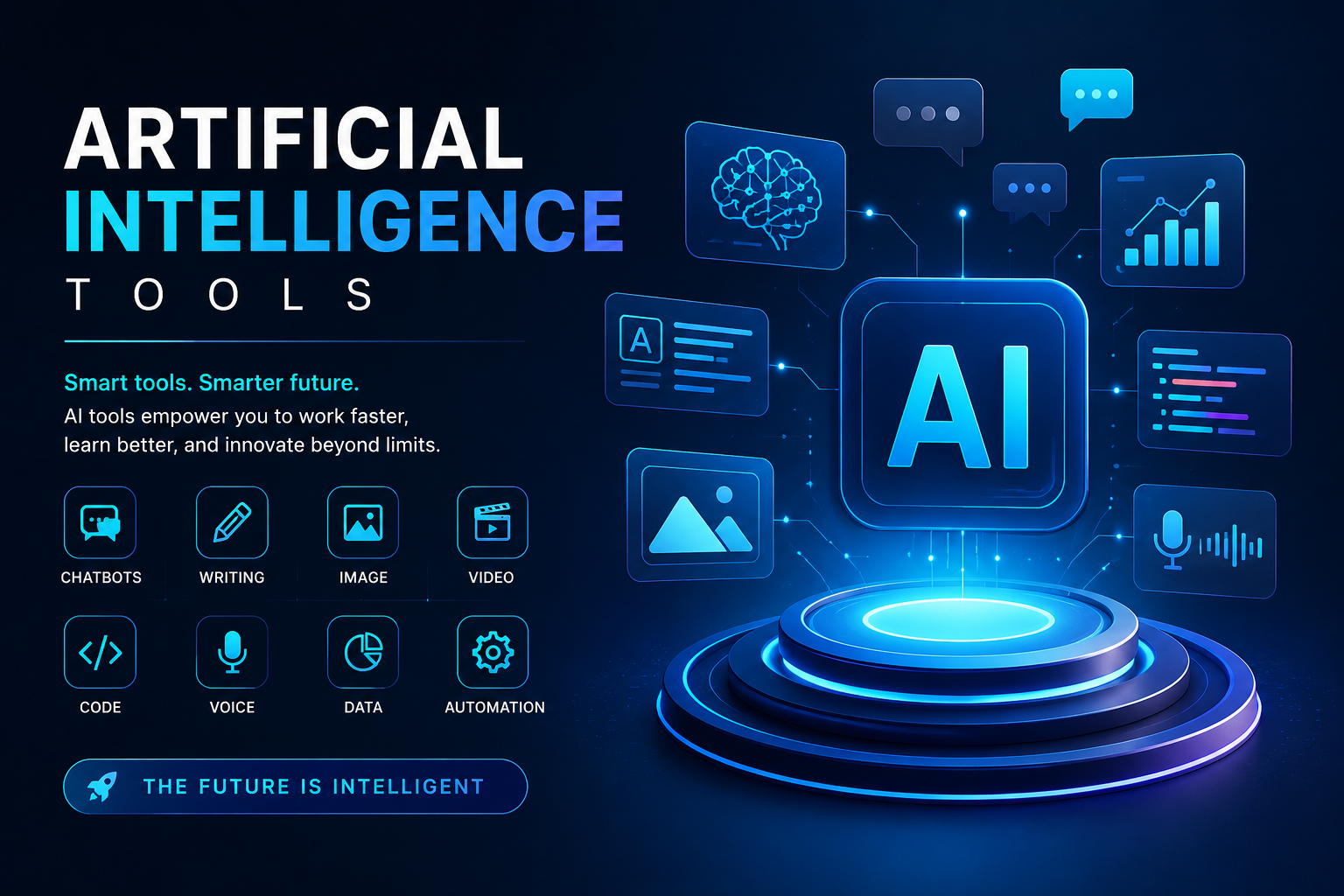
Artificial Intelligence (AI) has become one of the most transformative technologies of the 21st century. From automating repetitive tasks to generating creative content, AI tools are changing how people work, learn, communicate, and solve problems. Businesses, educators, students, healthcare professionals, and content creators are increasingly relying on AI-powered applications to improve productivity and efficiency. As AI continues to evolve, it is reshaping industries and creating new opportunities for innovation.
https://muuqtech.com/2026/06/25/artificial-intelligence-ai-transforming-the-future-of-humanity/
AI tools are software applications that use artificial intelligence technologies such as machine learning, natural language processing (NLP), computer vision, and deep learning to perform tasks that normally require human intelligence. These tools can analyze data, understand language, recognize images, generate content, automate workflows, and make predictions based on patterns.
Unlike traditional software that follows fixed rules, AI tools can learn from data and improve their performance over time. This makes them more flexible, intelligent, and capable of handling complex tasks. Artificial Intelligence (AI): Transforming the Future of Humanity – Muuqtech
The journey of AI began decades ago with simple rule-based systems. However, advancements in computing power, cloud technology, and large datasets have accelerated AI development significantly. The introduction of deep learning models and generative AI has enabled machines to understand context, create realistic text and images, and even engage in human-like conversations.
Today, AI tools are available across nearly every industry, making advanced technology accessible to businesses and individuals alike.
These tools assist users in creating articles, blogs, emails, marketing copy, scripts, and social media content. They can also help with grammar correction, rewriting, summarization, and translation.
Common uses include:
AI image generators create digital artwork, illustrations, logos, product designs, and realistic images from text descriptions.
Applications include:
AI-powered video tools simplify video production by automatically generating animations, editing footage, adding subtitles, and even creating AI avatars that can present information naturally.
These tools are popular among:
Speech AI tools convert text into natural speech and transform spoken words into written text. Some can even clone voices for entertainment and accessibility purposes.
Uses include:
Developers use AI coding tools to write code faster, debug software, explain programming concepts, and generate documentation.
Benefits include:
Businesses generate enormous amounts of data every day. AI tools analyze this information to identify patterns, predict trends, and support better decision-making.
Industries using data AI include:
AI-powered chatbots and virtual assistants provide 24/7 customer service by answering common questions, resolving issues, and guiding customers through processes.
Advantages include:
Designers use AI to generate layouts, color palettes, logos, presentations, and user interface designs.
These tools speed up:
AI automates repetitive and time-consuming tasks, allowing people to focus on creative and strategic work.
Many AI systems reduce human error by analyzing data with remarkable precision.
Businesses can reduce labor costs by automating routine operations while improving efficiency.
AI analyzes massive datasets much faster than humans, helping organizations make informed decisions.
Rather than replacing creativity, AI often enhances it by generating ideas, designs, and drafts that users can refine.
AI-powered systems operate continuously without breaks, making them ideal for customer support and automated services.
AI recommends products, content, and services based on user preferences and behavior.
AI assists teachers in creating lesson plans, grading assignments, and personalizing learning experiences. Students use AI for research, writing assistance, language learning, and tutoring.
Doctors use AI to analyze medical images, predict diseases, manage patient records, and assist with diagnoses.
Banks and financial institutions use AI for fraud detection, credit scoring, investment analysis, and risk management.
Marketing teams rely on AI for content creation, customer segmentation, campaign optimization, and market analysis.
Factories use AI for predictive maintenance, quality inspection, robotics, and production optimization.
Retailers use AI to forecast demand, manage inventory, personalize shopping experiences, and improve customer service.
Farmers use AI to monitor crop health, predict weather impacts, optimize irrigation, and improve yields.
Modern AI platforms commonly offer:
Despite their advantages, AI tools also present several challenges.
AI often requires access to user data, raising concerns about privacy and data protection.
AI systems can inherit biases present in their training data, leading to unfair or inaccurate outcomes.
Generative AI can produce incorrect or fabricated information if outputs are not carefully verified.
Automation may replace certain repetitive jobs while creating demand for new skills and professions.
Questions surrounding AI-generated content, copyright, accountability, and transparency remain important topics of discussion.
To maximize the benefits of AI while minimizing risks:
The future of AI is expected to be even more exciting. Emerging technologies will make AI more accurate, efficient, and personalized. Future AI systems may include:
As AI becomes more integrated into daily life, collaboration between humans and intelligent machines will become increasingly common.
Artificial Intelligence tools have revolutionized the way individuals and organizations work. They improve productivity, automate repetitive tasks, enhance creativity, and provide valuable insights from vast amounts of data. While AI offers tremendous opportunities, it also requires responsible use to address concerns related to privacy, bias, ethics, and accuracy.
Rather than replacing human intelligence, AI serves as a powerful partner that amplifies human capabilities. As technology continues to advance, AI tools will play an even greater role in education, healthcare, business, research, entertainment, and countless other fields. Individuals and organizations that embrace AI responsibly will be better positioned to innovate, adapt, and thrive in an increasingly digital world.
Muuqtech Media
